Friday, 20 May 2011

A long and winding Great Ocean Road

Having totally indulged in the peace and tranquillity of a lush pad in Sydney, it was time to hit the road again. Armed with maps, a full esky, a tent, a travelling companion and the obligatory sense of adventure we set off for one of the world's top ten road trips; the Great Ocean Road.


With 1000km on Betsy's clock, we arrived at the 12 Apostles. However, before I could even remove the lens cap to try and capture on camera these massive rock formations rising out of the ocean like high-rise layer cakes on an azure tablecloth, the sky turned an ominus grey. Within minutes, the sea diamonds turned into white horses and I watched in disbelief as a howling wind blew a curtain of rain across the classic view. Timing was never my strong point.


Driving from west to east with a day-long rainbow hanging over the water to our right, this famous drive was just as stunning as one would expect from one of the top ten drives in the world. What I didn't expect was for it to be so diverse. From the yellow limestone of the 12 Apostles, to the red sandstone of Split Point.

Vertigo-inducing cliffs and rocky shores morphed into wide sandy slices of surfer heaven. Long meandering rock face roads unfurled into tree canopied tracks leading to pockets of lush green rainforest reminiscent of some kind of Jurassic park while marshy bog-land brought me back to the wilds of Donegal.


As we drove around bends in Australia I was surprised to find myself arriving in various corners of Ireland; Malin Head in Donegal, Cushendall on the North Antrim Coast, the road to Inistigoe in Kilkenny, and the bit of the Rosslare-Dublin train track which almost falls into the sea around north Wicklow. Maybe it was the 'soft day' weather that was taking me back home.

Speaking of weather, it is really cold here now and I've even purchased hat, scarf and gloves so when Annie suggested camping I initially thought she had lost her mind, but agreed anyway as I'm operating on the basis of 'try anything once' (almost). We selected a campiste in the Otways National Park were likely to be pretty basic. It was dark when we arrived in Blanket Bay and as we drove down the 6km dirt road with a tree canopy so thick not even the full moon could penetrate it, I had the distinct feeling I had just entered 'Blairwitch' territory. Pretty soon though Annie had a reassuring fire going and I just dissolved into 'the vibe of it all' as we cooked our dinner by moonlight and defended it from the brazen nocturnal wildlife .

Maybe it was the bottle of red wine we drank with cheese and olives (classy campers, us) as we watched the glowing orange embers contrasted against the sharp moonlight shadows.
Perhaps it was the sleep-inducing hiss and spit of the fire and the thunder and rattle of waves. Or it could have been sedative effect of the warm, smoky Eucalyptus on the briny air.
  
Whatever the reason, I slept more soundly that night than I have done for a long time – and in recent times I have bedded down in everything from shacks and yurts, to comfortable homes and luxury ensuites.

In the morning we woke to the sight of the sun punching a hole in the cloud and bouncing off the waves 50 yards from where we slept. Just gorgeous.


The Great Ocean Road, long, winding and surprising in the most unexpected ways, is best enjoyed with a good companion and a willingness to veer off the beaten track now and again. A bit like life really.

Sunday, 15 May 2011

Love and Death at Sydney Opera House

Uluru and the Sydney Opera House were top of my 'must-see' list for this trip so today I left my little Sydney hideaway and spent the day at one of the most iconic architectural showpieces in the world, according to the tour guide, who also said that 2 of every 3 people on the planet recognise it.

Not quite sure where I was going, I ended up in the Botanical Gardens when, as if by magic, the familiar white sails (or shells, or kangaroo ears!) appeared from behind a group of fig trees. In the morning sun they did look mighty impressive and I suddenly got quite excited about the midday tour and the performance by the Sydney Symphony Orchestra that I had booked.


With some time to kill, I hadmorning coffee on the concourse with the Opera House towering over my right and the Harbour Bridge to my left.

I had a staring competition with a seagull. The seagull won. Unbelievably brazen, it actually landed on the table as I was sitting there.

The tour was excellent. Nice balance of history and useless information. Guess which I will remember. Here's a hint, did you know over 1 million cream tiles, imported from Switzerland, were used on the roof?  


Without doubt, the tour highlight was visiting the Concert Hall and the Opera Stage during rehearsals. The percussionists were rehearsing in the Concert Hall and the listening to, or rather feeling, those drums slowly build up to a crescendo and reverberate around that amazing space sent shivers up my spine. The space itself is remarkably light and airy with white birch used for the ceilings and seats. A colossal organ presides over the stage. I believe it is a baroque style organ but to my untrained eye it looks quite art deco. Unbelievably, it has over 10,000 pipes (I did actually check this figure), is 9 metres deep and took 10 years to build (see what I said about useless information?). What must it feel like to play something like that? Today, the organ was silent but two beautiful, black Steinways sat, side by side and centre stage, waiting to hold court.

With my appetite well and truly whet for the performance later we moved into the, surprisingly smaller, Opera Theatre. This is ballet season and the Gods must have been pleased with me today because by sheer luck, I got to watch the two principal dancers rehearse. No costumes, no lights, no orchestra. Without the distraction of 'the show', all the attention was focused on these two human butterflies floating around the stage in perfect unity with only a solitary piano for accompaniment. The movement was contemporary and complicated but so fluid, so delicate, so light it was both natural and supernatural at the same time. What those two dancers were able to express on that stage, in that time, was absolutely mesmerising.

I had lunch in the Opera House and indulged in a spot of people-watching. Interestingly, I didn't feel uncomfortable or conspicuous about being there on my own. Soon it was time to re-enter the Concert Hall for the main event. The performance was called 'Love and Death' and comprised two separate pieces of work.

The first was a recent commission by two concert pianists to celebrate their marriage. Very modern and playful, this 'Concerto for two pianos' was in two movements, representing two people becoming one. The first movement was very light and bright and actually a bit too jazzy for me with lots of raindrop percussion and a missing melody. Only during the second movement did the melody reveal itself and I think it was at that point that the female pianist rose from her Steinway and sat at her husband's Steinway to duet with him, representing the harmony of marriage. At this stage the feminist and the cynic in me both raised an eyebrow.

However, both eyebrows were lowered by the finale which was just gorgeous.


Following the interval, which I spent gazing out on the harbour from the upper foyer (the picture does not do the view justice), Mahler, or rather Vladimir Askenazy took the stage. This was a much more traditional performance and I happily just dissolved into 80 minutes of the rich, textured sound of the full Sydney Symphony Orchestra performing Mahler's 10th.

Mahler actually died before he completed this piece of work. He had scribbled "To live for you! To die for you!" in the margins of his notes and his wife believed he was writing the symphony as a love letter to her, despite just discovering her infidelity. The version I heard today was completed by Barshai in 2001 and is, I think, the most modern version. As the composer darted from one instrument section to another, the last movement felt almost painful and at one point I was reminded of a wake; the music tip-toeing around the stage in hushed tones, the orchestra saying their last goodbyes and then, eventually, like a happy release, the final note was one perfect, delicate tone that just peacefully faded away.
 
Afterwards, I sat outside at the Opera Bar for a post-Mahler merlot and fought off the dive-bombing seagulls as the sun set just to the left of the Harbour Bridge. I thought about the vision and resilience that Utzon, the architect of the Opera House, had shown. When he won the international competition to design it, the estimated bill was $7million and time to completion was 3 years. 16 years later, when the Opera House finally opened, the final bill came in at over $100millon. Thank God I wasn't project managing that one...

The next time I'm struggling with a deadline and/or budget I'm going to picture the Sydney Opera House.

Proof, if needed, that perseverance sometimes does pay great dividends.


Tuesday, 10 May 2011

Keeping it simple in Sydney


I'm house-sitting for friends of friends in one of the best cities in the world and I haven't left the house in three days. I set no alarm. I rise when I'm ready. I eat in silence. I sit and watch the sun dance across the pool. I go for a swim, a very short, very cold swim. I take a hot shower. I daydream. I play loud music. I dance 'cos nobody sees me. I sing out loud 'cos nobody hears me. I shout at the travel agent. I rest. I catch up on emails. I light the fire. I cook good food. I drink red wine. I read. I write. I recharge. I sort stuff out. I remember my own wee house, my home. I wonder where my next home will be. I think about the people important to me. I smile. I enjoy this little corner of heaven.

Thursday, 5 May 2011

Uluru

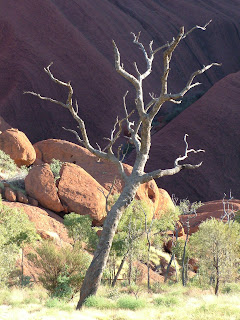
Landing in Ayers Rock airport is like landing on Mars. There is no doubting you have arrived in the red centre. At least when you drive the 500km from Alice Springs you can see the landscape gradually change, but I'm pretty sure Betsy would not have survived the road-trip. I must admit I was very envious of the Grey Nomads as they cruised into the camp ground with their white 4WD's covered in red desert dust. The high concentration of iron in the desert sandstone gives it an incredibly intense red ochre colour that only nature could make work with the azure blue sky and the green desert oaks. Stunning.

Until the 1980's anyone could (and did) camp right at Uluru which of resulted in a lot of damage to what is now widely accepted as a sacred Aboriginal site. The Uluru-Kata Tjuta National Park is a World Heritage site listed for both its natural and cultural values. To try and limit the tourist damage a dedicated resort was constructed about 25km away with all accomodation and all visitors based there. It is an exceptionally well-organised resort that supposedly caters for all budgets. It cost me $72 to camp in an unpowered site for 2 nights. Even the tiny airport is custom-built. Everyone who goes through that airport does so because of Uluru. Kata Tjuta, an even bigger rock formation with arguably, even more cultural and visual significance, is there too... but of course, like most people, I didn't visit that.  But I did get up at 5am to join an Uluru sunrise tour.

Being lucky enough to grow up where I did, spectacular sunrises are not unfamiliar to me. However, the 360 degree uninterrupted view of the dawn breaking in the desert and awakening Uluru, while the Southern Cross melted into the blue, purple, pink and orange sky, was quite something else. Moments like that always create a dilemma for me. Do I just stand and absorb it, or do I try to capture it? Thankfully, unable to focus in very low light, my Fuji finepix made the decision for me and I just stood and stared, and let it wash over me.


The rock itself is magnificent. Uluru comes to life during sunrise and sunset. From a distance shadows play across the surface and the range of colours; brown, plum, red, orange, pink, beige, makes it seem like the monolith is actually breathing. Rising out of the flat desert it stands tall and beautiful with grace and dignity as little people-ants scurry around it.

Following a 'bush breakfast' on the distant sand dune where we watched the sun rise in the bitter cold, we headed into the National Park to thaw out and to get a closer look at Uluru.

It really is immense; over half a km high and 3km wide with huge slashes and holes across recognisable as snakes and other creatures making it easy to see how the Aboriginal stories evolved.

In the afternoon I walked around the base of Uluru, almost 11km. Up close, it looks like a huge textured cloth,  with ornate twirls and twists, is carefully pinned over the whole rock. Sections of it look like a gigantic honeycomb tiger loaf or a massive tree trunk, other parts like slabs of Swiss cheese.


The walk was amazing. The colour, the texture, the beauty of the desert sand and the vibrant flora and fauna, like the five inch long Praying Mantra, the lizard and a moving train of about 20 'Hairy Mollys'. I knew when to get my camera ready based on the volume and pitch of the screams from the group of girlies in front of me. The flies were a bit of a trial and actively policed the place, making sure you didn't stop to take photos of the sections that were marked as sacred places for 'secret mens and secret womens business'.
Despite the site now being back in the ownership of the Aboriginal people living there (they now make up 75% of the management board of the resort and the National Park), there was a noticeable absence of Aboriginal people there. Even the staff in the Aboriginal cultural centre were predominantly non-Aboriginal. In fact, the whole time I was there I got the sense that I was being 'handled'. I also had a distinct sense of sadness of a lost people too. As the plane took-off  and the white clouds obscured my view of the red centre the sense of sadness lifted. As I started thinking about other things, the sun shot an accusing ray through the window. It caught my boot where a red sandstone stain remained in silent protest at my easy forgetfulness.

Uluru; spectacular, thought-provoking and worth seeing, and for a number of reasons this really was a 'once-in-a-lifetime' trip.